How to Read a Drain Survey Report: A Complete Guide
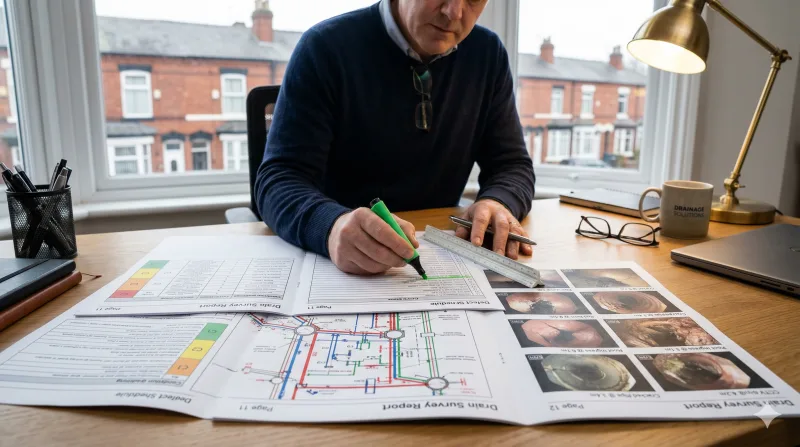
You have just received your CCTV drain survey report and it looks like it was written in a foreign language. Pages of codes, condition grades, and technical diagrams that seem impossible to decipher. You are not alone — most homeowners and even some property professionals find drain survey reports confusing at first glance.
This guide breaks down every section of a standard drain survey report so you can understand exactly what the engineer found, how serious any issues are, and what you need to do next.
What Is a Drain Survey Report?
A drain survey report is the formal document produced after a CCTV camera has been sent through your drainage system. The engineer records everything the camera captures — the condition of the pipes, any defects or damage, blockages, root ingress, joint displacements, and the overall structural integrity of your drains.
In the UK, professional drain surveys follow the WRc (Water Research Centre) Sewerage Rehabilitation Manual standards. This means the report uses a standardised coding system that any drainage professional can interpret, regardless of which company carried out the survey.
A proper report typically includes several key sections: a summary of findings, individual pipe run assessments with condition grades, defect codes with severity ratings, a drainage plan showing pipe routes and connection points, and recommendations for any remedial work.
Understanding the Drainage Plan
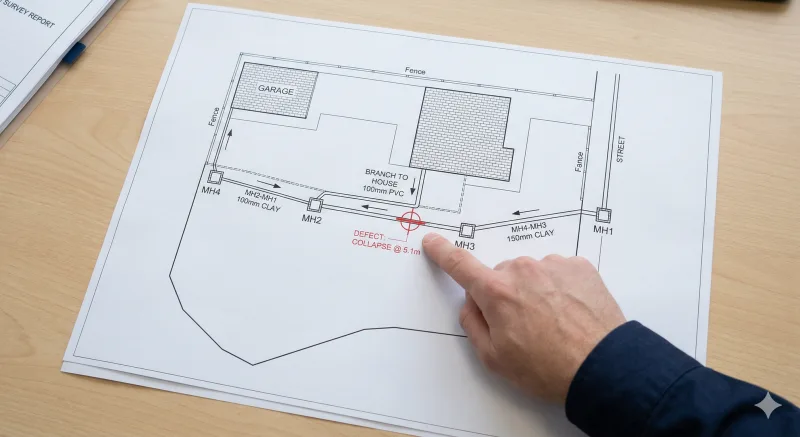
The drainage plan is usually the first thing you will see in the report. This is a schematic drawing — sometimes overlaid onto a site plan or floor plan — showing where all the drain runs, manholes, inspection chambers, and connections are located on your property.
Key Elements on the Plan
Every manhole and inspection chamber will be labelled with a reference number, such as MH1, MH2, or IC1. These reference numbers correspond to the detailed findings later in the report, so when you read that a defect was found between MH1 and MH2, you can look at the plan to see exactly where on your property that is.
Arrows on the plan show the direction of flow. Water and waste always flow downhill by gravity in a standard drainage system, so the arrows point from higher ground toward the main sewer connection. If the arrows seem to go in an unexpected direction, it could indicate a fall issue that the report will detail further.
Pipe diameters are noted along each run, typically 100mm for domestic drains and 150mm for shared or main runs. The pipe material is also recorded — you might see abbreviations like VC (vitrified clay), PVC (polyvinyl chloride), CI (cast iron), or CONC (concrete). Knowing your pipe material matters because it affects how vulnerable your drains are to certain types of damage.
WRc Condition Grades Explained
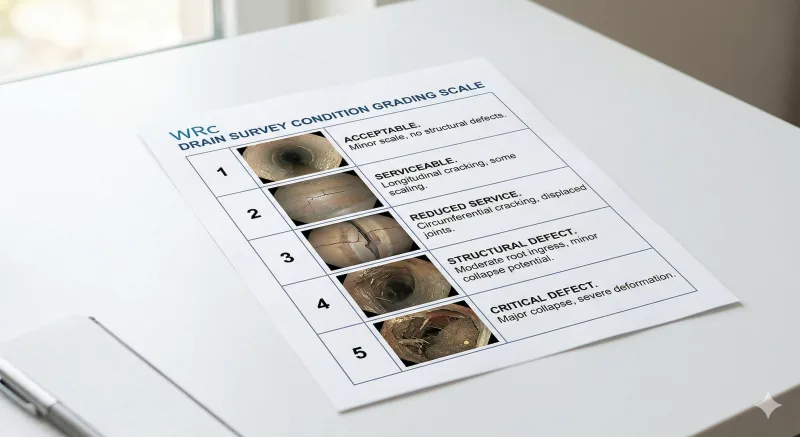
The condition grading system is the heart of any professional drain survey report. Each pipe run is assigned a structural condition grade and a service condition grade, both on a scale of 1 to 5.
Structural Condition Grades
Grade 1 means the pipe is in good condition with no structural defects observed. Minor surface marks or manufacturing variations might be present but nothing that affects the integrity of the pipe. This is what you want to see throughout your report.
Grade 2 indicates minor defects that are unlikely to deteriorate within the foreseeable future. Examples include slight joint displacement, minor cracking that has not opened up, or surface damage that does not compromise the pipe wall. No immediate action is required, but these sections are worth monitoring over time.
Grade 3 is where things become more significant. This grade means defects are present that will continue to deteriorate if left untreated. You might see moderate joint displacement allowing some soil ingress, cracking that has started to open, or early-stage root intrusion through joints. Grade 3 findings typically warrant repair within a planned maintenance schedule — not an emergency, but not something to ignore.
Grade 4 means the pipe has significant defects that are likely to cause problems in the near future. Severe joint displacement, fractured pipe sections, heavy root masses, or significant deformation all fall into this category. Repair or remediation should be treated as a priority.
Grade 5 is the most severe. The pipe has either collapsed, is on the verge of collapse, or has a defect so severe that it has already caused a failure in service. This requires urgent attention and usually means a section of pipe needs to be replaced entirely.
Service Condition Grades
Service grades assess how well the drain is actually functioning right now, separate from its structural integrity. A pipe could be structurally sound (Grade 1) but have a service issue like a partial blockage.
Service Grade 1 means flow is clear and unobstructed. Grade 2 indicates minor build-up or deposits that are not currently affecting flow. Grade 3 shows noticeable reduction in flow capacity. Grade 4 means the pipe is significantly obstructed. Grade 5 indicates a complete blockage or loss of service.
Common Defect Codes and What They Mean
Your report will list specific defect codes against each pipe run. These follow the WRc Manual of Sewer Condition Classification system. Here are the most common ones you will encounter.
Joint Defects
Joint issues are by far the most common finding in drain surveys, particularly in older clay pipe systems. Displaced joints (code DJ) occur when pipe sections have shifted at the connection point. A small displacement of a few millimetres is usually Grade 2. Once it exceeds about 10mm or allows visible soil ingress, it moves to Grade 3 or higher.
Open joints (OJ) are more serious — the pipes have separated enough to create a visible gap. This allows tree roots and soil to enter the drain, and if left unchecked, can lead to voids forming in the surrounding ground.
Cracks and Fractures
Longitudinal cracks (CL) run along the length of the pipe, while circumferential cracks (CC) go around the pipe. A hairline crack might be Grade 2, but once a crack has opened or pieces of pipe have started to break away, you are looking at Grade 3 or higher.
A fracture (F) means a piece of the pipe wall has broken but is still roughly in position. A broken pipe (B) means pieces have fallen out or collapsed into the channel. Multiple fractures in one section almost always warrant a pipe replacement.
Root Intrusion
Root intrusion (R) is graded by severity. Fine roots at a joint (often called a root curtain) might be Grade 2 if they are not restricting flow. A root mass (RM) that has grown thick enough to catch debris and restrict flow is Grade 3 or 4. In severe cases, roots can completely fill the pipe bore and cause repeated blockages.
If your report shows root intrusion, it means there are trees or large shrubs near the drain run. The report should note which joints are affected. Simply cutting roots with a mechanical cutter provides temporary relief, but the roots will grow back. A lasting solution usually involves sealing the joints with a patch liner or replacing the affected section.
Deformation
Deformation (D) applies mainly to plastic pipes and means the pipe has lost its circular shape, usually due to external loading or poor installation. A 5 percent deformation is generally acceptable. Once it exceeds 10 percent, it is graded more severely because the pipe is under stress and flow capacity is reduced. Deformation beyond 15 percent usually requires replacement.
Other Common Findings
Infiltration (I) means groundwater is entering the pipe through a defect. You might see it described as a seep, drip, or running infiltration depending on severity. Scale or encrustation (S or EN) is a build-up on the pipe walls, commonly found in older cast iron pipes. Debris (DE) is any material sitting in the pipe — silt, gravel, or general waste.
How to Read the Defect Schedule
The defect schedule is a table that lists every observation the engineer made, in the order they were recorded along each pipe run. Each entry includes the distance from the starting manhole (so you know exactly where the defect is), the defect code, a severity rating, the clock position (using a clock face to describe where on the pipe wall the defect is located — 12 o’clock is the top, 6 o’clock is the bottom), and often a brief description.
For example, an entry might read: 3.2m — DJ — Medium — 3 o’clock — Joint displaced 8mm with minor soil ingress. This tells you that 3.2 metres from the starting manhole, there is a displaced joint on the right side of the pipe, shifted by 8mm, and soil is getting in.
Pay particular attention to clusters of defects. A single Grade 2 displaced joint is nothing to worry about. But five displaced joints in a 10-metre section with root intrusion suggests that stretch of pipe is deteriorating and needs attention as a priority.
What Does a Good Report Look Like?
A drain in good condition will show mostly Grade 1 structural and service ratings across all pipe runs. You might see the occasional Grade 2 finding on joints — this is completely normal, especially in older properties where clay pipes have been in the ground for decades.
The drainage plan will show clear, logical pipe routes with adequate fall. Flow will be recorded as clear in all sections. There should be no signs of root intrusion, infiltration, or significant deposits.
If your report looks like this, you can be confident that your drainage system is functioning well and is unlikely to cause problems in the foreseeable future.
What Does a Bad Report Look Like?
Warning signs to look for include any Grade 4 or Grade 5 findings, which require urgent or priority action. Multiple Grade 3 defects in the same pipe run suggest systemic deterioration rather than an isolated issue.
Root intrusion at multiple joints indicates an ongoing problem that will recur without proper repair. Heavy infiltration suggests the pipe is acting as a land drain, which can cause ground movement issues over time, particularly in clay soils common across Manchester.
Evidence of previous patch repairs or concrete encasement might indicate the drains have a history of problems. Belly or sag in the pipe (a dip where the pipe has settled) creates a low point where water pools and debris collects, leading to recurring blockages.
If your report contains these issues, the recommendations section becomes critically important.
Understanding the Recommendations
A professional drain survey report should not just list problems — it should tell you what to do about them. The recommendations section will outline suggested remedial works, typically in order of priority.
Common recommended repairs include drain lining (also called CIPP or cured-in-place pipe lining) for Grade 3 defects where the pipe is still largely intact, localised patch repairs for isolated joint defects, excavation and replacement for collapsed or severely damaged sections, root cutting followed by patch lining to seal affected joints, and high-pressure water jetting for service condition issues like build-up or debris.
Each recommendation should reference the specific defects it addresses, so you can cross-reference with the defect schedule and drainage plan.
What to Do After Reading Your Report
Once you understand your report, your next steps depend on the severity of the findings. If everything is Grade 1 or 2, file the report safely — it is a valuable document for future property transactions and gives you a baseline for comparison if issues arise later.
For Grade 3 findings, get quotes for the recommended remedial works and plan them into your maintenance budget. These are not emergencies but should not be left indefinitely.
Grade 4 and 5 findings need prompt attention. Get quotes from drainage contractors who can carry out the specific repairs recommended. If you are in the process of buying a property, these findings give you strong grounds to renegotiate the purchase price or request the seller addresses the issues before completion.
If anything in your report is unclear, a reputable drainage company will walk you through the findings and footage. At Manchester CCTV Drain Survey, we include a full consultation with every report to make sure you understand exactly what we have found and what your options are.
Frequently Asked Questions
How long is a drain survey report valid?
There is no official expiry date, but drainage conditions can change over time. A report is generally considered current for around 12 months for property transaction purposes. If you are using a report for insurance or legal matters, check with the relevant party whether they have specific requirements.
Can I get a second opinion on my drain survey report?
Yes. Because WRc coding is standardised, any qualified drainage engineer should be able to review the CCTV footage and the report. If you are unsure about findings or recommended works, getting a second opinion is perfectly reasonable, especially before committing to expensive repairs.
Do I need a drain survey before buying a house?
We strongly recommend it. A drain survey can reveal thousands of pounds worth of hidden problems that a standard homebuyer survey will not detect. We have written a detailed guide on drain surveys before buying a house that covers everything you need to know.
What if my report shows problems on the public sewer?
If defects are found on the section of pipe that is the responsibility of the water authority (typically the public sewer beyond your property boundary), you should report these to your local water company. In Manchester, this is usually United Utilities. They are responsible for repairing public sewers at no cost to you.
Get a Professional Drain Survey in Manchester
If you need a CCTV drain survey with a clear, comprehensive report that you can actually understand, we are here to help. Every survey we carry out in Manchester comes with a full WRc-standard report, annotated drainage plan, and a face-to-face or phone consultation to walk you through the findings.
Get a free quote for your drain survey today, or call us to discuss your requirements.
Need professional advice?
Our Manchester drainage engineers are happy to discuss your situation. Call us for a free, no-obligation chat.