CCTV Drain Survey vs Drain Inspection — What's the Difference?
In short: A CCTV drain survey is a full inspection of your entire drainage system with a full written report. A drain inspection is a targeted check of one problem area, and it costs less because it covers less ground. Choose a full survey for property purchases, insurance, or building work. Choose an inspection for a known, local issue — send a quote request online for either.
Key Facts
- A full CCTV drain survey covers the entire system with a full written report
- A targeted drain inspection covers a specific problem area, and is priced accordingly
- 1–3 hours on-site for a full survey vs 30–60 minutes for a targeted inspection
- WRc condition grading is included with a full survey but not with a basic inspection
- The inspection is the more affordable option because the camera work and report cover less ground
People often use the terms “drain survey” and “drain inspection” as if they mean the same thing. Customers do it, plumbers do it, and even some drainage companies do it. However, the two services are not the same, and knowing the difference can save you money. Here is a clear guide to what each one involves, when you need one over the other, and what you should expect to receive.
What Is a CCTV Drain Survey?
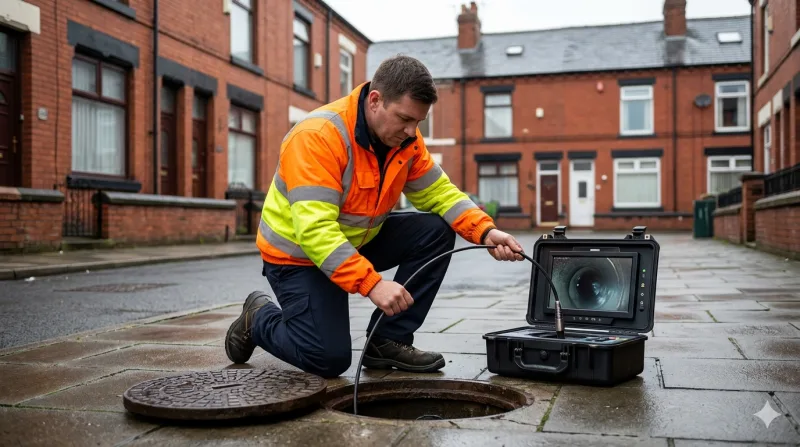
A CCTV drain survey examines your entire drainage system. In particular, it is the full picture — a systematic check of every accessible drain run from your property to the point where it connects to the public sewer.
What It Involves
During a full CCTV drain survey, an engineer will:
- Locate and open all accessible manhole covers and inspection chambers on and around the property.
- Map the drainage layout — identifying each drain run, noting pipe materials, diameters, and depths where possible.
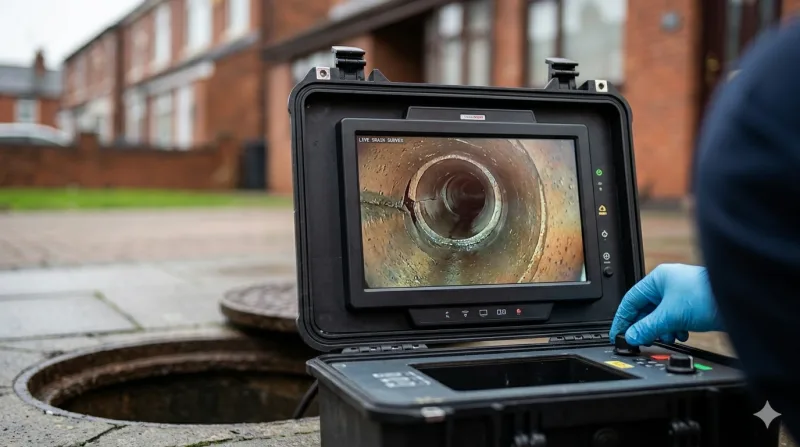
- Insert a camera into each drain run. Record footage of the full length, from one access point to the next.
- Systematically inspect every section, noting the condition of the pipe, any defects, joint condition, flow characteristics, and any signs of damage or deterioration.
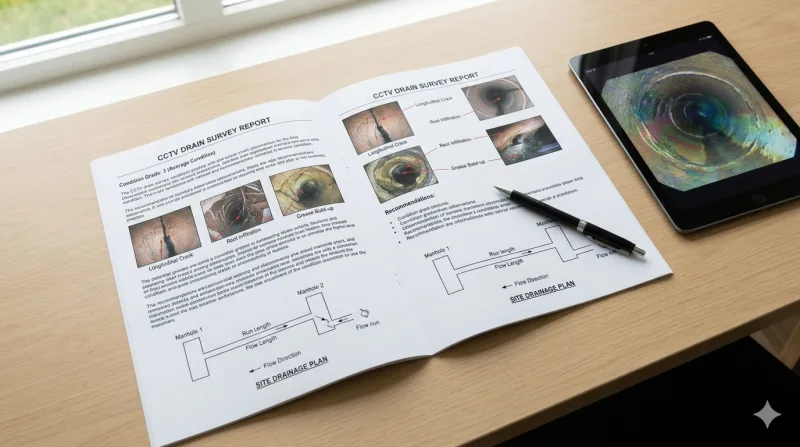
- Produce a detailed written report including condition grading for each section, descriptions and images of any defects found, a drainage plan, and prioritised recommendations for repair or monitoring.
The whole process typically takes one to three hours on site for a standard residential property. It depends on the size and complexity of the system. Afterwards, the engineer spends more time reviewing footage and preparing the report.
What You Receive
A full CCTV drain survey gives you:
- Video footage of the entire drainage system
- A written report with condition grading (typically using the WRc system, the industry standard)
- Annotated still images of significant defects
- A drainage plan showing the layout of your system
- Recommendations classified by urgency — what needs fixing now, what should be monitored, and what is cosmetic or minor
For a more detailed guide to report contents, see what is included in a drain survey report.
What Is a Drain Inspection?
A drain inspection is a more targeted, focused look at one part of your drainage system. While a survey checks every pipe beneath your property, an inspection zeroes in on a particular area, usually to investigate a known or suspected problem.
What It Involves
A drain inspection typically involves:
- Identifying the area of concern — based on symptoms you describe (slow drainage, gurgling, odour, damp) or a specific location (the kitchen drain, the downstairs toilet, the gully outside the back door).
- Inserting a camera into the relevant drain run and recording footage to identify the cause of the problem.
- Providing a diagnosis on site — the engineer explains what they have found and recommends next steps.
- Providing footage and a summary — you receive the video recording and a brief written or verbal summary of findings.
A drain inspection moves faster. It typically takes half an hour to an hour on site. The scope stays narrower, and the reporting is less formal than a full survey.
What You Receive
From a drain inspection, you get:
- Video footage of the inspected section
- A diagnosis of the specific issue
- Verbal or brief written recommendations for repair
- Enough information to get repair quotes or decide on next steps
Since an inspection stays narrow in scope, you will not usually get the full written report, condition grading, or drainage plan that comes with a survey.
Key Differences at a Glance
| Feature | CCTV Drain Survey | Drain Inspection |
|---|---|---|
| Scope | Entire drainage system | Specific section or problem area |
| Duration on site | 1–3 hours | 30–60 minutes |
| Report | Full written report with grading | Brief summary or verbal feedback |
| Drainage plan | Yes — system layout documented | No — focused on the problem area |
| Defect classification | Formal grading (WRc system) | Informal description |
| Video footage | Full system recording | Targeted recording |
| Typical cost (Manchester) | Higher — reflects full system coverage | Lower — targeted to one area |
| Best for | Property purchases, full system assessment, insurance, pre-extension | Investigating a specific blockage, smell, or suspected defect |
When Do You Need a Full Survey?
A full CCTV drain survey is the right choice when:
You Are Buying a Property
If you are buying a house or flat in Manchester, a full survey matters a great deal. You need to know the condition of the whole system, not just one section. A costly problem can sit anywhere in the drainage network, often in a section you would never think to check specifically.
A homebuyer drain survey follows a structured format designed to give your solicitor and mortgage lender the information they need. A targeted inspection, however, would not do the job here.
You Want a Complete Picture of Your Drainage
Perhaps you have lived in your Manchester property for years and never had the drains checked. You are not seeing a problem right now, but you want to know the condition of the system, especially if you have an older property with clay or pitch fibre pipes. A full survey gives you a documented baseline, so you know what to watch and what might need attention in the coming years.
You Are Planning Building Work
Before you extend your property, convert a cellar, or build over a drain, you need to know exactly where the drains run and their condition. Building control will want this information, and your builder will need it too, so they can plan the work properly. A full survey with a drainage plan is the right tool for this.
Insurance or Legal Requirements
Insurance claims, boundary disputes involving shared drainage, and building regulation applications typically call for a formal survey report. A quick inspection summary, in contrast, will not carry the same weight.
If you are unsure whether you need a full survey or a targeted inspection, get in touch and describe your situation. Sending a request puts you under no obligation.
When Is an Inspection Sufficient?
A drain inspection is the right choice when:
You Have a Specific, Localised Problem
If your kitchen sink drains slowly, the downstairs toilet gurgles when flushed, or there is a bad smell from a specific gully, you already have a rough idea where the problem lies. Since you already know roughly where to look, a targeted inspection can confirm the cause quickly, at a lower cost than a full survey.
You Want to Check Whether a Repair Has Worked
After drain repair work, a quick inspection can verify that the repaired section works correctly. You do not need to re-survey the entire system, since only the worked-on area matters here.
You Had a Blockage Cleared and Want to Know Why
Say a plumber has just cleared a blockage. A follow-up inspection of that section can reveal whether an underlying structural defect caused it, such as a displaced joint, crack, or belly in the pipe, or whether it was simply a build-up of grease or debris. This helps you decide whether you need to take further action.
Budget Is a Primary Concern
If money is tight and you have a specific issue to investigate, an inspection gives you the information you need at a lower price point. You can still upgrade to a full survey later, if the inspection turns up something that warrants a closer look.
Can an Inspection Lead to a Survey?
Yes, and this is a common progression. Say a homeowner in Fallowfield has a blocked drain. An inspection shows a displaced joint caused the blockage, but it also shows the pipe is pitch fibre, which tends toward further problems. A full survey to check the rest of the system becomes the sensible next step.
In these cases, ask whether the cost of the first inspection can be credited against the full survey price, so you do not pay twice.
This is actually a sensible approach if you are not sure what level of service you need. Start with an inspection, get a professional opinion, and then decide whether a full survey makes sense based on what turns up.
Common Misconceptions
“A survey is just an inspection with a fancier name”
This is the most common misunderstanding. The scope, method, and end result genuinely differ. A survey is a systematic look at the whole system. An inspection targets one specific area. Think of the difference between a full MOT and asking a mechanic to check a noise your car is making.
“I only need one drain run checked, so I need an inspection”
Not necessarily. Say you are buying a property and only care about one drain run, perhaps because the vendor mentioned a past blockage. You should still get a full survey. That one run might be fine, while a collapsing Victorian barrel drain sits on the other side of the house that nobody mentioned.
“An inspection will tell me enough to negotiate on a house price”
It might give you some ammunition. Still, a solicitor or lender will want a formal survey report with condition grading and a drainage plan. An informal inspection summary does not carry the same weight in property negotiations.
“A survey takes all day”
For a standard residential property in Manchester, a full survey typically takes one to three hours. Larger or more complex properties take longer, but it is not an all-day affair. You do not even need to stay home for the whole process, since the engineer just needs access to manhole covers, which usually sit outside.
Cost Comparison: Is the Survey Worth the Extra Money?
In Manchester, the price gap between an inspection and a full survey is usually modest, relative to the extra information a full survey gives you. Request quotes for both and compare.
Consider this scenario: you pay for an inspection that shows a grease build-up caused the blocked drain outside your kitchen. You get it cleared and carry on. Six months later, the drain under the lounge, which nobody inspected, collapses, and a full survey would have flagged the deterioration before it failed.
On the other hand, if you have a simple blocked drain and just want to know what is causing it, a full survey with a formal report is probably more than you need.
The right choice depends on your situation. A good drainage company will help you decide rather than simply push you towards the pricier option.
Which Service Should You Book?
To summarise:
Book a full CCTV drain survey if:
- You are buying or selling a property
- You want a comprehensive condition assessment
- You are planning building work near drains
- You need a formal report for insurance or legal purposes
- You have an older property and have never had the drains checked
Book a drain inspection if:
- You have a specific problem to investigate
- You want to check a repair has worked
- You know which part of the system needs looking at
- You want a quick diagnosis before deciding on next steps
Not sure which you need? Contact us and describe your situation. Use the lists above to decide — if an inspection will do the job, ask for an inspection rather than a full survey. No obligation.
Local notes
Planning a survey nearby? See the area notes for drains in Bromley Cross, drains in Castleton, drains in Cheadle, drains in Chorlton and drains in Denton. Each area page lists its common drain problems and the surveys you can request there.
Need a CCTV drain survey?
Send one short request. A drainage engineer can quote for a camera survey of your drains. There is no obligation to book.