What Is Included in a Drain Survey Report?

In short: A professional drain survey report includes several core parts: HD video footage, a drainage plan, WRc condition grading (Grade 1–5) for every pipe run, and a defect schedule with locations and severity. It also includes annotated still images, a flow assessment, and prioritised repair advice with cost estimates. The premium for a full written report over a basic inspection summary is modest. Ask the engineer to confirm it in your written quote.
Key Facts
- 7 core components in a professional report: property details, drainage plan, HD footage, condition grading, defect schedule, annotated images, and recommendations
- WRc Grade 1–5 standardised system used across the UK drainage industry
- The premium for a full written report over a basic verbal summary is modest — ask for a written quote to confirm it
- Grade 3+ defects include annotated still images showing exactly what the problem is
- Drainage plan shows every pipe run, manhole, connection point, and flow direction
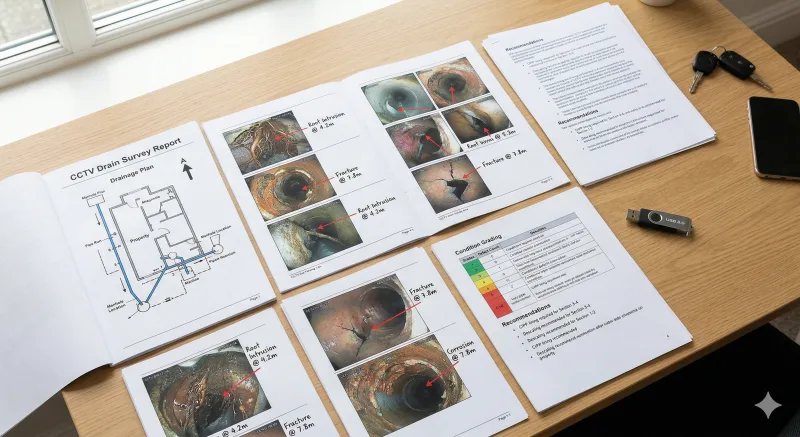
You have had a CCTV drain survey done, or you are thinking about booking one. You want to know what you will actually get. A drain survey report is a detailed document, but it should also read clearly enough that a non-specialist can follow it. However, it should still let you make informed decisions from the findings. Here is a full breakdown of what a good report includes and how to read it. It also covers what sets a good report apart from a poor one.
The Components of a Professional Drain Survey Report
1. Property and Survey Details
The report begins with the basics. These details set the scene before the findings start:
- Property address and a description of the property type
- Date of survey and name of the surveying engineer
- Client details — who commissioned the survey and for what purpose
- Weather conditions at the time of survey — relevant because heavy rain affects flow levels and can mask or exaggerate certain defects
- Equipment used — the camera type, diameter, and recording format
- Scope of the survey — what was inspected and, importantly, any areas that could not be reached and why
This section sets the context. Since a dispute could arise about the findings, the report needs to show exactly when and how the survey happened. It should also note the conditions the engineer worked under.
2. Drainage Plan / Layout Drawing
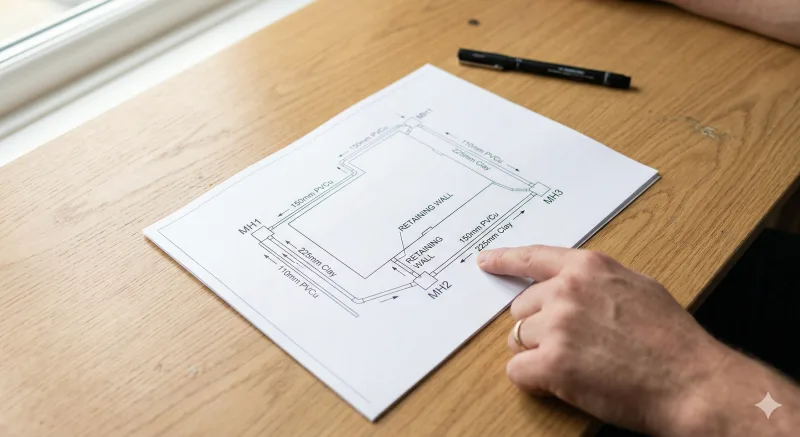
A drainage plan is a bird’s-eye-view drawing of the drainage system as found during the survey. It shows:
- The position of each manhole, inspection chamber, and access point relative to the property and its boundaries
- The direction and route of each drain run — where each pipe goes and what it connects to
- Pipe materials and diameters for each section
- Flow direction — indicated with arrows
- Connection points — where branch drains join the main run
- The location of the public sewer connection (if accessible)
- Any features of note — shared drainage, abandoned connections, live connections from neighbouring properties
This plan is very useful if you are planning building work, or looking into a specific problem. It also helps if you simply want to know where your drains run. Many home owners have no idea what sits beneath their feet, and the drainage plan fills that gap.
For homes in Manchester City Centre and the inner suburbs, drainage layouts can be surprisingly complex. Original Victorian systems have often seen decades of later additions, re-routes, and connections. Builders did not always do this work to a high standard.
3. HD Video Footage
You receive the full video recording of the survey digitally. It usually comes as a download link, USB drive, or through an online portal. As a result, the footage covers every metre of pipe the engineer checked. An on-screen distance counter lets you match what you see to specific spots on the drainage plan.
Good footage comes in HD with proper lighting. You should be able to clearly see:
- The pipe wall condition — cracks, fractures, deformation
- Joint condition — whether joints are aligned, displaced, or open
- Any obstructions or debris
- Root growth
- Water flow and level
- Changes in pipe material or diameter
The footage is your evidence. Therefore, if a seller, an insurer, or a contractor disputes a defect, the video gives clear proof of what the engineer found.
4. Condition Grading
This is where a professional report differs most from a basic inspection summary. The engineer assesses and grades each section of drainage using a standard system.
The industry standard in the UK is the WRc (Water Research Centre) system, which grades pipe condition on a number scale. Here is what the grades mean in practical terms:
Grade 1 — Acceptable condition. The pipe is in good working order. Minor cosmetic defects may be present — slight discolouration, minor surface deposits. None of this affects strength or flow. No action needed.
Grade 2 — Minor defects. The pipe has defects that do not currently affect function, but you should keep an eye on them. Examples include hairline cracks that are not leaking, and slight joint displacement under 10% of pipe diameter. Minor root ingress that is not slowing flow also counts. Recommended action: check again every 2-5 years.
Grade 3 — Defects needing attention. The pipe has defects that will likely worsen over time, so plan to repair them at a convenient time. Examples include moderate joint displacement, established root ingress causing partial blockage, circumferential cracks, and moderate scale build-up. Recommended action: repair within 12 months.
Grade 4 — Significant defects. The pipe has serious defects that are actively affecting function and will keep getting worse. Examples include severe joint displacement, dense root masses, partial collapse, and heavy deformation of pitch fibre pipes. Recommended action: repair as soon as practically possible.
Grade 5 — Urgent / collapsed. The pipe has failed or is about to fail. Full collapse, complete blockage, or structural failure that risks flooding or more damage. Recommended action: immediate repair.
This grading system gives you a clear, fair way to rank repairs. A Grade 2 defect can wait. However, a Grade 5 defect cannot.
5. Defect Schedule
The defect schedule is a detailed list of every defect found during the survey, set out in table format. For each defect, the report typically records:
- Location — identified by the drain run reference and distance from the camera entry point (e.g., “Run A, 4.2m from MH1”)
- Defect type — using standardised terminology (displaced joint, fracture, root ingress, deformation, etc.)
- Severity — classified according to the grading system
- Description — a plain-English explanation of what was observed
- Still image — a frame captured from the video footage showing the defect
- Recommended action — what should be done and when
A thorough report might list anywhere from zero defects to twenty or more, in a large or older home. However, not every defect requires action — the grading system tells cosmetic issues apart from genuine problems.
6. Annotated Still Images
Still images, captured from the video footage, illustrate key defects. Arrows, labels, or short descriptions mark them up to highlight exactly what the image shows. Not everyone can read drain camera footage with ease. For them, these annotated images are usually the most useful part of the report.
A good report includes still images of:
- Every significant defect (Grade 3 and above)
- Each change of pipe material
- Each junction and connection point
- Any area of concern even if graded as minor
- The overall condition of representative sections
7. Flow Assessment
The report should comment on flow conditions observed during the survey. A few things matter here:
- Water level in each section — is the pipe running at normal depth, or is there standing water indicating a belly or obstruction downstream?
- Flow rate — is water moving freely, or is it sluggish?
- Surcharging — is the pipe running full, indicating a capacity problem or downstream obstruction?
- Infiltration — is groundwater entering the pipe through defects? This is identifiable by clear water seeping in through joints or cracks.
Flow observations provide context for the structural findings. For example, a displaced joint that is also slowing flow is more urgent than one sitting in a section with good flow.
If you have received a drain survey report and are unsure how to read the findings, ask the engineer who wrote it. They can walk you through it. If you need a survey done, get in touch and ask for the kind of detailed drain survey reports that non-specialists can actually follow.
8. Recommendations and Urgency Classification
The final section of the report brings it all together with clear, ranked advice. It splits into four groups:
- Urgent repairs — defects that need addressing immediately or within a short timeframe to prevent flooding, further damage, or health risks
- Planned repairs — defects that should be repaired within the next 6-12 months to prevent deterioration
- Monitoring — defects that are minor and stable, but should be re-inspected in 2-5 years to check for progression
- No action required — sections in good condition that do not need any intervention
Each entry sets out the repair method — excavation and replacement, re-lining, patch repair, root cutting, descaling, and so on. It also gives a rough idea of the likely cost range. As a result, you have enough to get quotes from drainage contractors and plan your budget for the work.

How Different People Use the Report
A drain survey report serves multiple purposes, depending on who is reading it. Different readers look for different things:
Homebuyers
If you are buying a home, the report tells you the condition of the drainage system. It flags any problems that could cost you money after completion. You forward the report to your solicitor, who can raise enquiries with the seller’s solicitor. Common outcomes include:
- Price reduction to reflect the cost of required repairs
- Seller agreeing to carry out repairs before completion
- Retention of funds until repairs are completed
- In extreme cases, withdrawal from the purchase
For homebuyer drain surveys, the report format fits the home purchase context. It gives clear summary findings that solicitors and mortgage lenders can act on, which keeps the buying process moving without delay.
Insurance Companies
Insurers require drain survey reports when assessing claims for drainage damage, subsidence, flooding, or escape of water. The condition grading, defect type, and video evidence give insurers the clear records they need to process a claim. Because of this, a well-structured report with WRc grading carries more weight than a verbal description or informal summary.
Building Contractors and Architects
Before building over or near a drain, or when planning an extension, contractors and architects need to know the drainage layout and condition. As a result, the drainage plan shows where pipes run. Builders can then avoid them, or protect them properly, during construction. The condition report also flags any existing defects to fix before work begins.
Property Owners
Even if you are not buying, selling, or claiming on insurance, the report gives you a written record of your drainage system’s condition. You know what is there, what condition it is in, and what — if anything — needs attention. As a result, this puts you in control rather than waiting for a crisis.
What Makes a Good Report vs. a Poor One
Not all drain survey reports measure up equally. Here is what to look for, and what to watch out for.
Signs of a Good Report
- Comprehensive coverage — every accessible drain run is surveyed and reported on, not just the obvious or easy-to-reach sections
- Clear structure — logical layout with sections for each drain run, consistent formatting, easy to navigate
- WRc grading — defects classified according to the industry standard system, not just vague descriptions
- Annotated images — still images with clear labels showing exactly what the defect is
- Plain English explanations — technical findings translated into language that a non-specialist can understand
- Specific recommendations — not just “requires repair” but “displaced joint at 4.2m from MH1, recommend excavation and replacement of 1m section” with a written repair quote to follow
- Drainage plan — a clear layout drawing showing the system as found
- HD footage — provided in a viewable format with distance counter
Signs of a Poor Report
- Missing sections — only part of the system surveyed with no explanation of why other areas were excluded
- Vague descriptions — “some defects noted” without specific locations, classifications, or images
- No grading system — findings described in informal language with no objective condition assessment
- Poor quality footage — grainy, poorly lit, or provided in an unusable format
- No drainage plan — footage and commentary only, with no visual representation of the system layout
- Generic recommendations — “further investigation recommended” without specifying what, where, or why
- No still images — relying entirely on the video footage to communicate defects
If you receive a report that falls into the “poor” category, it may not serve its intended purpose. A solicitor reviewing a homebuyer report needs specific, graded findings, not a vague summary. Similarly, an insurer needs documented evidence, not a verbal opinion. A contractor needs accurate locations and measurements, not approximate descriptions.
Understanding Defect Terminology
Survey reports use standard terms to describe defects. Here is a glossary of the most common ones you will meet:
- Displaced joint (DJ): Pipe sections have moved out of alignment at a joint. Measured as a percentage of pipe diameter.
- Open joint (OJ): A gap has opened between pipe sections at a joint, exposing the surrounding soil.
- Circumferential fracture (CF): A crack running around the circumference of the pipe.
- Longitudinal fracture (LF): A crack running along the length of the pipe.
- Multiple fracture (MF): Several cracks in different directions, often indicating structural stress.
- Collapse (X): Pipe has caved in, partially or completely.
- Deformation (D): Pipe has changed shape from its original circular profile. Common in pitch fibre and some plastic pipes.
- Root ingress (RI): Plant roots have entered the pipe.
- Infiltration (I): Groundwater is entering the pipe through defects.
- Encrustation (EC): Mineral deposits built up on the internal pipe surface.
- Debris (DE): Loose material in the pipe — silt, gravel, or broken pipe fragments.
- Belly / sag: A dip in the pipe gradient creating a low point where water pools.
- Connection defect (CD): A branch connection is poorly made — projecting into the main pipe, at a bad angle, or unsealed.
Each of these carries a severity scale. As a result, the defect type and severity together set the condition grade for that section of pipe.
Do You Always Need a Full Report?
Not always. Say you are having a drain inspection to check a specific blockage or a repair. In that case, a verbal summary with video footage may be enough. You know what the problem is — you just need confirmation and a plan to fix it.
But say you are buying a home, making an insurance claim, planning building work, or want a full record of your drainage condition. In any of these cases, a full written report is essential. The cost difference between a survey with a report and one without is small. Still, that modest premium buys you a document that can save a great deal in home price talks, insurance claims, or repair planning.
You can request a CCTV drain survey anywhere in Manchester and Greater Manchester. Ask for a report with HD footage, WRc condition grading, annotated images, a drainage plan, and clear recommendations. Book your survey or learn more about drain survey reports.
Local notes
Planning a survey nearby? See the area notes for drains in Cheadle, drains in Denton, drains in Dukinfield, drains in Heaton Moor and drains in Middleton. Each area page lists its common drain problems and the surveys you can request there.
Need a CCTV drain survey?
Send one short request. A drainage engineer can quote for a camera survey of your drains. There is no obligation to book.