Pitch Fibre Drains in Manchester: Risks, Detection, and Repair

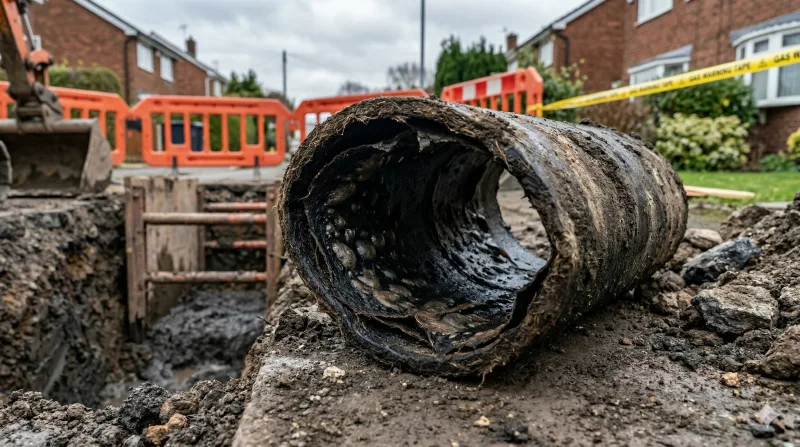
If you are buying a house in Manchester built between 1950 and 1980, there is a significant chance it has pitch fibre drainage. Pitch fibre was once considered a good solution — lightweight, cheap, easy to install. Now, after 40–70 years in the ground, these pipes are deteriorating rapidly, and the material is notorious in the drainage industry as a problem waiting to happen.
This guide explains what pitch fibre is, why it fails, which Manchester areas are most affected, how to detect it, and what your repair options are.
What Is Pitch Fibre?
Pitch fibre is a composite material made from wood fibres bound together with coal tar pitch. It was developed in the 1920s and widely adopted for drainage pipes from the 1950s onwards. The material was marketed as revolutionary — lighter than clay, cheaper than cast iron, and supposedly as durable as either.
In the 1950s and 1960s, that marketing was persuasive enough. Builders across Manchester used pitch fibre extensively in new housing. By the 1980s, as the first problems started appearing, the material was gradually phased out in favour of PVC.
The problem is fundamental: pitch fibre absorbs moisture from the soil and the drainage environment. Over time, the coal tar pitch binder softens, the wood fibres weaken, and the pipe deteriorates. After 40–50 years, delamination (internal layers separating) becomes visible. After 50–70 years, the pipe is often unsafe.
How Pitch Fibre Fails
Pitch fibre pipes fail in several predictable ways:
Blistering
The internal surface of the pipe forms blisters — bubbles where the internal lining separates from the structural layer. These blisters catch debris and cause blockages. Blistering reduces the effective bore of the pipe by 30–50% in severe cases.
Delamination
The pipe layers — the internal lining, the structural fibres, and the external coating — start to separate. This is visible on camera survey as internal debris and breakdown of the pipe structure. Once delamination starts, it accelerates.
Softening and Collapse
The coal tar pitch binder softens and loses structural strength. The pipe wall becomes flexible and deforms. In severe cases, the pipe collapses under the weight of the soil above it, creating a blockage.
Cracking and Fracturing
As the material loses strength, the brittle outer layer cracks. Water infiltrates through the cracks, accelerating deterioration. Cracks also allow soil to enter the pipe.
Root Ingress at Joints
As the pitch fibre softens and joints become loose or brittle, roots find it easy to penetrate. A root ingress problem that might take decades in a clay pipe system can develop in just 3–5 years in deteriorated pitch fibre.
Where Pitch Fibre Is Most Common in Manchester
Pitch fibre was used most heavily in Manchester’s post-war housing developments. The areas most likely to have pitch fibre drainage are:
Wythenshawe
Wythenshawe is perhaps the single largest concentration of pitch fibre drainage in Manchester. The estate was developed from the 1920s onwards, with major expansion in the 1950s and 1960s. Houses built during the 1950s–1970s boom almost certainly have pitch fibre. If you are buying a Wythenshawe property, assume it has pitch fibre unless you have evidence otherwise.
Langley
The Langley estate (north-west Manchester) was developed in the 1950s–1970s and heavily used pitch fibre. Similar to Wythenshawe in terms of age and material choice.
North Manchester Post-War Estates
Areas like Cheetham Hill, Crumpsall, and parts of Moston that were redeveloped in the 1950s–1970s commonly have pitch fibre.
South Manchester Suburbs
Some 1950s–1960s developments in suburbs like Heaton Moor, Cheadle, and parts of Stockport (adjacent to Manchester) may have pitch fibre, though south Manchester housing tends to be older or newer, with less 1950s development.
City Centre Redevelopments
Parts of Manchester city centre that were bombed in World War II and redeveloped in the 1950s–1960s may have pitch fibre drains, though some of these areas have had more recent drainage upgrades.
Why Pitch Fibre Is Problematic When Buying
If you are buying a property in one of these areas built between 1950 and 1980, the drainage condition is a major consideration. Pitch fibre failure is not a matter of if — it is a matter of when.
A property with pitch fibre drains that are visibly blistered and delaminating (Grade 3 or higher on a drainage survey) should be significantly cheaper than a property with sound modern drainage. Use the survey findings to negotiate the price down or ask the seller to replace the drains before completion.
A property with pitch fibre that is still relatively sound (Grade 2) is in a grey area — it is likely to need replacement or re-lining within 5–10 years, which is something to factor into your offer.
Some buyers in Wythenshawe and Langley actively plan for pitch fibre replacement within the first few years of ownership — it is treated as an inevitable cost, like replacing windows or the roof, rather than an unexpected problem.
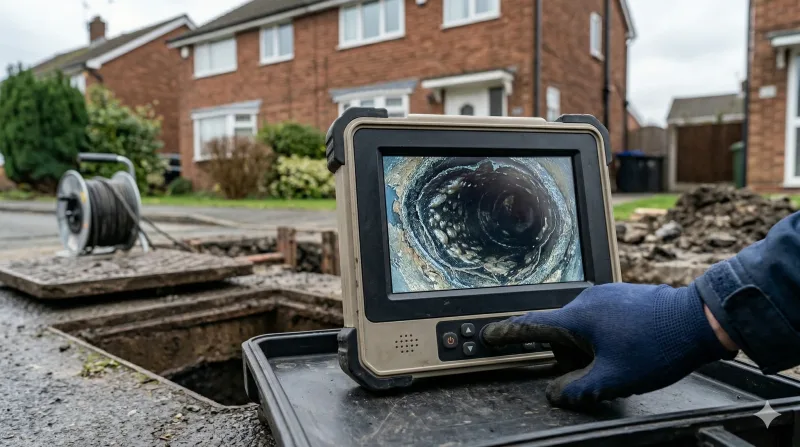
Detecting Pitch Fibre — What a Drain Survey Shows
A professional CCTV drain survey will identify pitch fibre pipes on sight. The appearance is distinctive:
- Colour: Typically dark grey or black, sometimes with a sooty appearance.
- Joints: Visible as distinct rings where pipe sections connect. Pitch fibre joints are often vulnerable points where delamination and failure start.
- Delamination: Visible as loose internal material, flaking, or separation of layers.
- Blistering: Visible as bumps or bubbles on the internal surface.
- Deformation: The pipe may not be perfectly round — it may have flattened or collapsed sections.
- Age-related appearance: A 50–70 year old pitch fibre pipe looks damaged and deteriorated, even if it is still structurally functional.
The survey will grade the condition of each section using the industry standard system (Grade 1–5). A newly installed pitch fibre pipe would be Grade 1 or 2. A 60-year-old pitch fibre pipe is typically Grade 3 or higher.
Repair Options for Pitch Fibre Drains
Once you know you have pitch fibre drains and they are showing signs of deterioration, your options are:
Option 1: Re-Lining (CIPP)
Re-lining is the most popular option for deteriorated pitch fibre. A flexible liner impregnated with epoxy resin is inverted into the pipe (or pulled through it) and then cured, creating a new structural pipe inside the damaged one.
Re-lining works well for pitch fibre because:
- It does not require excavation, so there is no need to break up paths, patios, or driveways.
- It stabilises the pipe and prevents further collapse.
- It restores the bore of deformed pipes.
- It is relatively quick — a 30m run can be done in a day or two.
Cost: £1,500–£3,500 for a standard residential run (30–40m), depending on the pipe diameter and any complications.
Lifespan: A re-lined pipe typically lasts 30–50 years, depending on conditions.
Considerations: Re-lining requires access to both ends of the pipe (through manhole covers or rodding points). If the pipe is completely blocked, it must be cleared before lining. If the pipe has collapsed in a section, re-lining may not be possible in that section.
Option 2: Excavation and Full Replacement
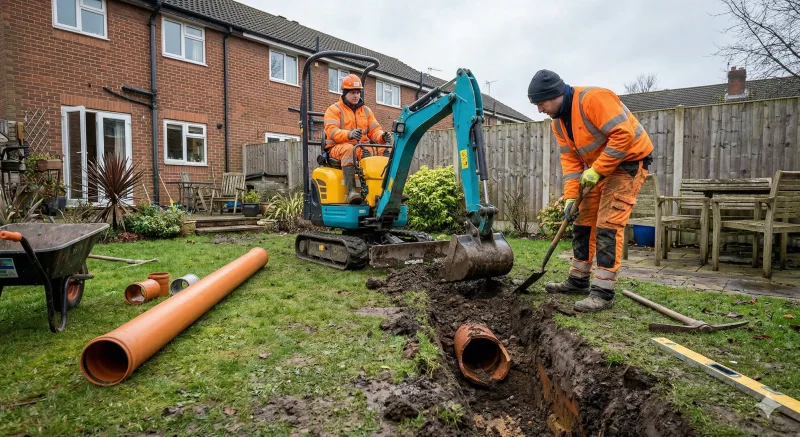
For severely damaged or collapsed pitch fibre, excavation and replacement with modern PVC pipe is sometimes necessary.
The contractor excavates along the affected run, removes the old pitch fibre, and installs new PVC pipe with proper bedding and compaction. Any structures above (paths, patios, driveways) are removed before excavation and reinstated afterwards.
Cost: £2,000–£6,000 depending on the length, depth, and the extent of reinstatement work needed.
Lifespan: Modern PVC pipe lasts 50+ years and is extremely durable.
Considerations: Disruptive if it means breaking up hard landscaping. Takes longer than re-lining. More expensive upfront. However, it completely removes the problem and replaces it with modern materials.
Option 3: Monitor and Manage
For pitch fibre that is showing age but is not yet failing structurally (Grade 2), some property owners choose to monitor and manage rather than preemptively replace.
This means:
- Regular drain clearance if blockages develop.
- Re-surveying every 3–5 years to track deterioration.
- Planning for re-lining or replacement before a complete failure occurs.
Cost: £80–£150 per blockage clearance, re-survey every 3–5 years at £150–£250.
Risk: If the pipes deteriorate faster than expected, you may face an emergency failure and need costly emergency repairs.
This approach works if you are committed to staying in the property long-term and do not mind ongoing maintenance. It does not work if you plan to sell in the next 5 years — a pitch fibre drain showing visible deterioration will require disclosure to buyers.
The Most Common Scenario in Wythenshawe and Langley
If you are buying a post-war property in Wythenshawe or Langley, here is the likely scenario:
A survey will show pitch fibre drains that are 50–70 years old. They will show visible signs of age — delamination, blistering, joint deterioration — and will be graded Grade 3 or higher.
The owner will typically either:
- Negotiate a price reduction reflecting the cost of re-lining (£2,000–£3,500).
- Ask the seller to commission the re-lining before completion.
- Plan to have the re-lining done in the first year of ownership.
Some properties in these areas have already been re-lined, in which case the survey will show modern lining and the problem is resolved.
The key is not to be surprised by the finding. Pitch fibre in post-war Manchester is normal, not exceptional. It is a predictable cost that should be factored into your decision about whether to buy, at what price, and when to address the repair.
Building Control and Planning Implications
If you are planning any building work (an extension, a new garage, etc.) and you have pitch fibre drains in the area, Building Control will want to know about the drainage condition.
If the drains are structurally sound, you can build over or near them without issue. If they are deteriorated and near to failure, Building Control may require you to replace or re-line them before building work is permitted. The cost then falls to you.
This is another reason to address pitch fibre issues proactively. It is less painful and cheaper to re-line the drains when you plan to do it, rather than being forced to do so by Building Control when you want to build an extension.
The Bottom Line
Pitch fibre drains were a poor long-term choice, but they are extremely common in post-war Manchester. If you are buying a property built between 1950 and 1980 in areas like Wythenshawe or Langley, expect to find pitch fibre drains that are showing age.
A CCTV drain survey will identify the exact condition and allow you to plan repairs. In most cases, re-lining is the practical solution — non-invasive, not too expensive, and durable.
Avoid being caught out by failing to survey. Discovering severe pitch fibre deterioration after you have exchanged contracts means you own the repair cost. A survey before you buy gives you the information to negotiate the price or plan the repair on your own timeline.
If you are buying a post-war property in Manchester and want to know the condition of the drainage, a homebuyer drain survey is essential. Get in touch to book a survey — we specialise in identifying and advising on pitch fibre and other drainage issues in Manchester’s post-war housing.
Need professional advice?
Our Manchester drainage engineers are happy to discuss your situation. Call us for a free, no-obligation chat.