How Long Does a Drain Survey Take?

In short: A standard residential CCTV drain survey takes 1–2.5 hours on site, depending on property size and complexity. The written report usually takes 5–10 working days, and some companies offer a two-day service for a premium. From booking to report in hand, expect 2–4 weeks on a standard timeline, or as little as 4–5 days if urgent.
Key Facts
- 1–1.5 hours on-site for a small 2-bed terraced house
- 1.5–2.5 hours for a 3–4 bed semi-detached or detached property
- 5–10 working days standard report turnaround after the site visit
- Two-day expedited reports are offered by some companies for a premium — ask the engineer whether this is possible
- 4–5 days total from booking to report for urgent pre-exchange surveys
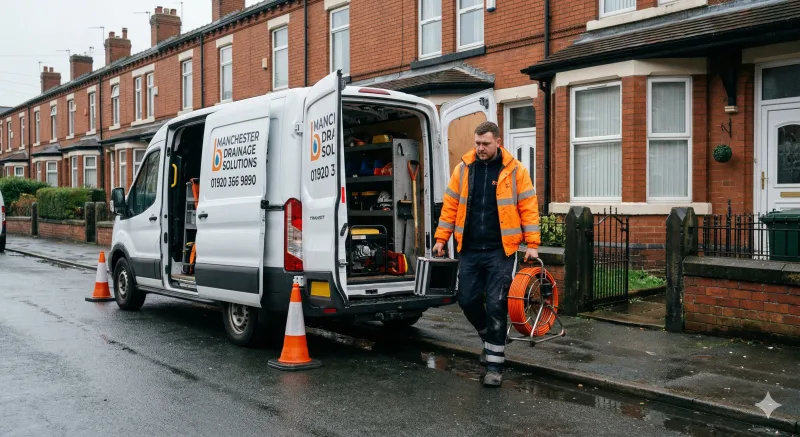
“How long will it take?” is one of the first questions people ask when they book a drain survey. The answer depends on a few things. This guide sets out what to expect, from the time on site to the day the report lands in your inbox.
On-Site Survey Time
The time an engineer spends at your home varies with the size and layout of your drains. Below is a rough guide, since every property is a little different.
Small Properties (2-Bedroom Terraced House)
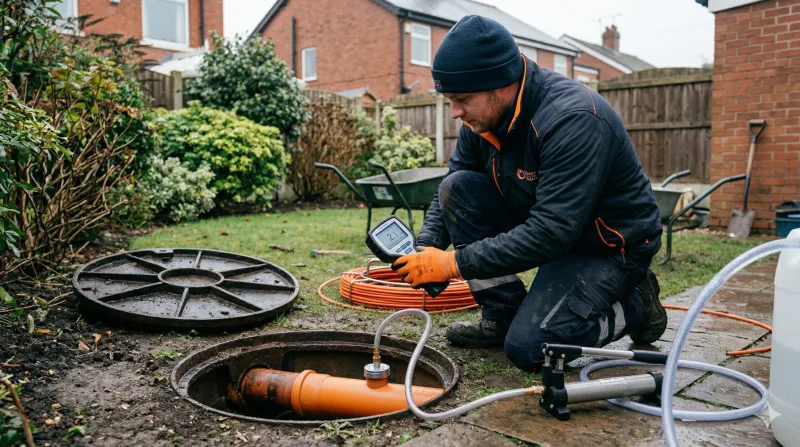
Estimated time: 1 to 1.5 hours. A small terraced house usually has one main drain run, from the back of the house to the public sewer. During the visit, the engineer will typically:
- Locate the manhole covers (5 minutes).
- Gain access and set up the camera equipment (10 minutes).
- Push the camera through the drain (10–15 minutes depending on the length of the run).
- Review the footage and note findings (5 minutes).
- Give you a verbal summary (10 minutes).
A few things can stretch this out. Times shift a little because access and blockages vary from house to house:
- How easily manhole covers are accessed. Covers buried under soil, hidden under paving, or stiff from disuse take longer to open.
- The length of the drain run. A short 10-metre run is quicker to check than a 20-metre one.
- Whether the drain is partially blocked. A blockage slows the camera down as it passes through.
Medium Properties (3-4 Bedroom Semi or Detached)
Estimated time: 1.5 to 2.5 hours. A larger semi or detached house often has more than one drain run — separate foul and surface water systems, or branches serving an extension or outbuilding. Because each run needs its own camera pass, the time adds up:
- First run: 20 minutes to half an hour.
- Second run: 20 minutes to half an hour.
- Third run (if present): 15–20 minutes.
- Verbal summary and site notes: 15 minutes.
Total time runs 1.5 to 2.5 hours, depending on access and the number of runs. However, tight access or an extra branch can push it toward the higher end.
Large Properties or Complex Layouts
Estimated time: 2.5 to 4 hours. A large detached home, a property with a big extension, or one with several drainage systems can take much longer to check fully. For example:
- A large Victorian villa with separate foul and surface water, an extension with its own drain, and outbuildings could have 4–5 distinct drain runs.
- More runs mean more camera insertions, each taking 20 minutes to half an hour.
- Older properties sometimes have abandoned drains that still need a look and a classification.
A complex property can take 3–4 hours, especially where access is tight. Still, most jobs finish well within a single morning or afternoon.
Commercial Properties
Estimated time: 2 to 6 hours. Commercial sites are bigger and more complex, so they take longer to survey:
- A small retail unit: 1.5 to 2 hours.
- A medium office or restaurant: 2 to 4 hours.
- A large building with several floors and systems: 4 to 6 hours or more.
Commercial surveys also involve extra testing, such as water pressure and infiltration checks, plus more detailed paperwork. Because of this, the on-site time runs longer than a typical home visit.
What Affects On-Site Duration?
A few factors can make a survey run faster or slower than average. Access, weather, and the age of your property all play a part.
Access to Manhole Covers
Manhole covers set the pace. How quickly the engineer reaches them shapes the whole visit:
- Easily accessible: The survey moves quickly when covers sit in open concrete or paving on the drive or in the garden.
- Difficult to access: Covers buried under soil, hidden under decking, or grown over with plants take extra time to find and clear.
- Missing or inaccessible: A missing or damaged cover means the engineer must use another entry point, such as a rodding point or the soil stack. This adds time to the visit.
Blockages in the Drain
If the drain has a partial or full blockage, the camera cannot pass through freely. The engineer will usually:
- Try to push through gently with the camera.
- If this fails, withdraw and report that the drain is blocked.
- Recommend a drain clearance before the full survey can continue.
A partial blockage adds around 10–15 minutes, since the camera has to push through slowly. A complete blockage stops the survey at that point.
Weather
Heavy rain can also affect timing. Wet weather changes both access and safety on site:
- A flooded property, with standing water in the drains, makes access unsafe, so the engineer may postpone the visit.
- Wet ground makes access harder and muddier underfoot.
- Dry weather works best, although a survey can still go ahead in light or moderate rain.
Property Age and Condition
Older properties with complex layouts take longer to survey. A Victorian home with combined foul and surface water, brick barrel drains, and past modifications is far more involved to check than a modern home with straightforward PVC pipework.
Number of People Present
If you want to watch the survey, the engineer can explain the findings and show you the footage as they go. A survey done without you present tends to move slightly faster.
Report Turnaround Time
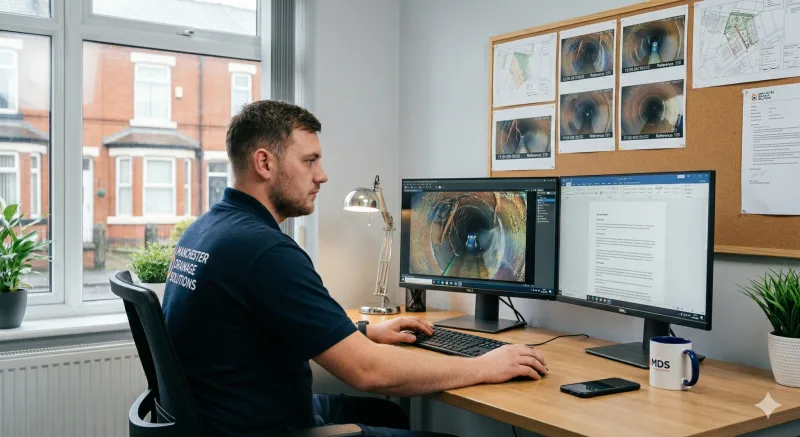
The on-site visit is only the first part. The engineer still has to review the footage, write up the findings, and put the report together.
Standard Report Turnaround: 5-10 Working Days
A typical drain survey report takes 5–10 working days to finish. In that time, the footage gets reviewed, defects get identified, images get annotated, and the written report gets drafted and checked.
The surveying company will usually work through a similar process. The steps typically run like this:
- Download and review the video footage (1–2 days).
- Identify and classify defects using the industry grading system (1–2 days).
- Capture and annotate still images (1 day).
- Write the report and prepare the drainage plan (2–3 days).
- Proof and quality-check the finished document (1 day).
Expedited Reports: Two Days
Some companies offer an expedited report in two days, usually for a premium. This can help if you are about to exchange contracts on a property purchase — ask the engineer to confirm the cost in your written quote.
An expedited report normally covers the key findings and images, although it may carry less detailed annotation than a full report done at the usual pace.
Slow Reports: 2-3 Weeks
Some operators take 2–3 weeks to produce a report, particularly if they are busy or have a backlog. This is not unreasonable, but it is still worth confirming the turnaround time when you book.
For homebuyers and insurance claims, a 5–10 day turnaround is usually enough. If you need the report sooner, ask about the expedited option when booking.
Total Timeline from Booking to Receiving Report
Here is the typical run from the moment you decide to book a survey to the day the final report arrives. Timings can shift slightly depending on the company and the time of year.
Scenario 1: Standard Booking
- Days 1–3: Find a surveying company, get a quote, book a convenient date.
- Days 4–10: Wait for the appointment (depends on company availability; many can survey within the first week after booking).
- Day 11: Survey conducted (on-site time: 1–2 hours for most residential properties).
- Days 12–21: Report written and delivered (typically 5–10 working days).
Total time: 3–4 weeks from initial booking to receiving the report.
Scenario 2: Urgent Booking (Before Property Exchange)
- Day 1: Find a surveying company, request urgent booking.
- Day 2 or 3: Survey conducted (many companies can arrange an urgent visit within a day or two if you push).
- Days 4–5: Expedited report delivered (two-day option if you pay the premium).
Total time: 4–5 days from booking to receiving the report.
This timeline is realistic once you reach the point of needing a survey urgently before a purchase. Still, you need to plan ahead and book quickly to hit it.
Scenario 3: Commercial or Complex Survey
- Days 1–5: Find a company specialising in commercial surveys, negotiate scope and scheduling.
- Days 6–20: Wait for appointment (commercial surveys may take longer to arrange, since they often need after-hours or weekend access).
- Days 21–25: On-site survey (2–6 hours depending on complexity).
- Days 26–40: Detailed report completed (10–15 working days for a complex commercial survey).
Total time: 5–8 weeks from initial inquiry to receiving the report.
When to Book Your Survey
If you are buying a property and want a survey before exchange, a little planning helps. Here is what to do:
- Book the survey as soon as your offer is accepted. Do not wait for the house survey results or searches to finish.
- Request a date within 1–2 weeks of booking. This gives the company time to fit you in without a long delay.
- If you are close to exchange, ask about an expedited report (two-day option) when you book.
The whole run, from accepted offer to report in hand, can fit into 2–3 weeks if you prioritise it. That keeps you well ahead of a typical exchange deadline, usually 6–8 weeks after your offer is accepted.
Do You Need to Be Present?
You do not need to be there during the survey. The engineer can access the property and carry out the survey without you. Some surveyors even prefer this, since it keeps the visit quick and straightforward.
That said, many property owners like to watch. It gives you a chance to understand the findings as they happen and to ask questions.
If you do plan to attend, a little preparation helps the visit run smoothly. Keep the following in mind:
- Set aside 1–2 hours, plus extra time if the engineer needs to explain findings in detail.
- Make sure someone is available to give access and answer basic questions about the property.
- Have a cup of tea ready — surveyors appreciate it!
Property Access Arrangements
For the survey to go ahead, the property needs to be accessible. Access arrangements depend on your situation:
- If you own the property: Arrange access yourself. Unlock the back garden if needed.
- If you are buying: Coordinate with the estate agent to arrange access. The agent can usually meet the engineer or hand over a key.
- If the property is empty: Keys can be collected from the estate agent or a keyholder.
- If you are a landlord arranging a survey on a rental property: Give the tenant reasonable notice, usually at least a day, and make sure the engineer can get in.
A lack of access to manhole covers or back gardens delays the survey. Confirm that every area will be reachable before you book.
The Bottom Line
A typical residential drain survey takes 1–2.5 hours on-site, depending on the size and complexity of the property. The written report takes another 5–10 working days. From booking to report in hand, the total is usually 2–4 weeks.
If you need a survey urgently, for example before a property exchange, expedited options can shrink that timeline to 4–5 days from booking to report — though you will pay a premium for the speed.
Ready to book a survey? Get in touch — we’ll pass your request on straight away. Ask the engineer for the earliest available slot and when your written report will be ready.
Local notes
Planning a survey nearby? See the area notes for drains in Lees, drains in Ramsbottom, drains in Rochdale, drains in Royton and drains in Tameside. Each area page lists its common drain problems and the surveys you can request there.
Need a CCTV drain survey?
Send one short request. A drainage engineer can quote for a camera survey of your drains. There is no obligation to book.