Drain Survey for Extension Planning in Manchester

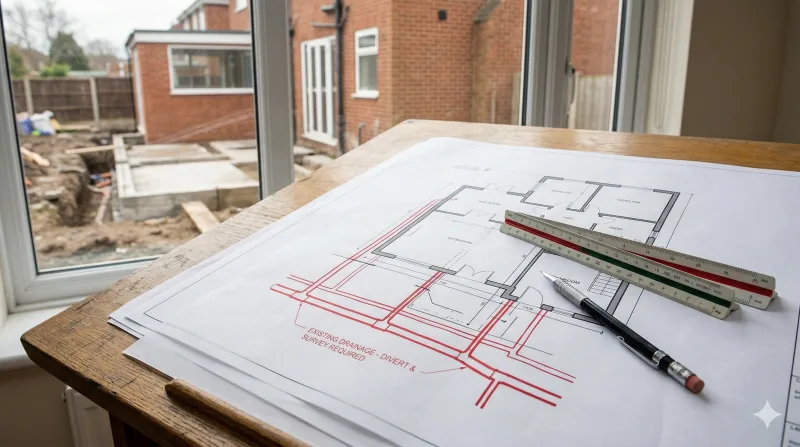
If you are planning an extension in Manchester — a rear extension, a side extension, or a loft conversion with new bathrooms — Building Control will want to know where your existing drains are. More importantly, if your drains are in poor condition, Building Control may require you to fix them before you are allowed to build.
This guide explains why a drain survey is essential before planning an extension, what Building Control requires, and how to avoid costly mistakes.
Why Drain Location Matters Before an Extension
Building over a drain, or too close to one, creates several problems:
Damage Risk
If you excavate for an extension foundation and accidentally rupture a drain, you have a serious problem — contaminated soil, potential flooding, and expensive emergency repairs. Even careful work can damage pipes if you do not know exactly where they are.
Future Access Problems
Once you have built over a drain, accessing it for maintenance or repair becomes difficult or impossible. If the drain fails after you have completed the extension, getting it repaired may require breaking up your new building.
Building Control Rejection
Building Control will not approve plans for an extension if existing drains are in the building area and cannot be safely dealt with. You need to either:
- Route the drain around the new building.
- Replace or relocate the drain before building starts.
- Obtain written agreement from Building Control that the drain is safe and can be built over (rare).
Insurance and Resale Issues
Building over a failing drain can create insurance and resale problems. If the drain fails after the extension is built, your insurance may refuse to pay if the damage is linked to building over a known defect.
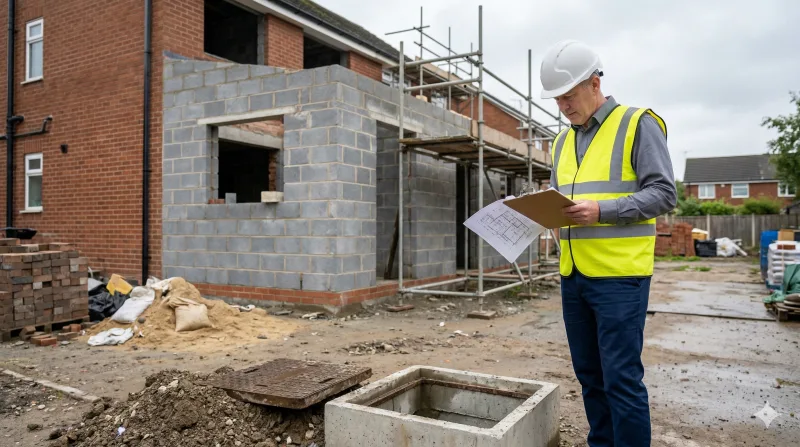
What Building Control Requires
Building Control approval for an extension requires (among other things):
A Drainage Plan
You must show on your extension plans exactly where existing drains are located. This allows Building Control to assess whether the new building will interfere with them.
For a rear extension, the plans should show:
- The position of the main drain and any branch drains.
- The location of manhole covers and inspection chambers.
- The direction of flow.
- The location of the public sewer connection.
Proof of Drain Condition (if Drains Are in the Building Area)
If your extension is going to be built over or very close to an existing drain, Building Control will want to know the condition of that drain. They will ask one of two questions:
-
Is the drain in good condition? If yes, you can get permission to build over it, though you will need to install a suitable cover or protection.
-
Is the drain defective? If yes, Building Control may require you to replace or re-line it before building starts, or to relocate it outside the building footprint.
A CCTV drain survey provides the evidence Building Control needs. The survey report, with video footage and condition grading, allows them to make a decision about whether building over the drain is acceptable.
Scenario 1: Drain Not in Building Area
Ideal situation: Your extension is planned for an area where no existing drains run. In this case:
- You still need a drainage plan showing where drains are (to confirm they are not affected).
- A survey may not be essential, though it is still sensible to have one so you know the full extent of your drainage system.
What You Need for Building Control
- Marked-up plans showing the extension footprint and the location of existing drains (from your property deeds or a simple survey).
- Plans for new drainage connections if the extension adds new bathrooms or kitchens.
Cost Impact
Minimal. A basic drain identification (sometimes done with a metal detector and visible manhole covers) may be sufficient. If you want a full survey, it costs £150–£250 and takes a few days.
Scenario 2: Drain in or Near Building Area (Sound Condition)
Common situation: Your extension is planned for the rear of the property, and the main drain runs across the rear garden in the direction of the extension.
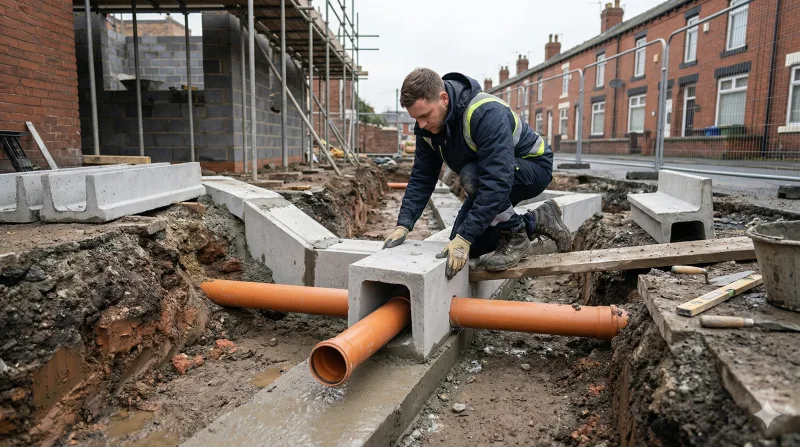
If a survey shows the drain is in good condition (Grade 1 or 2), Building Control will allow you to build near or over it, provided:
-
The drain is protected. This usually means installing a concrete duct or surround around the pipe so it is not directly loaded.
-
The drain remains accessible. You must maintain access to manhole covers for future maintenance.
-
The plans clearly show the protection measures.
What You Need for Building Control
- A CCTV drain survey report with condition grading showing the drain is in good condition.
- Revised extension plans showing protective measures (typically a reinforced concrete surround or protective duct around the pipe).
- Confirmation from the contractor that the drain will be protected during excavation and building.
Cost Impact
- Drain survey: £150–£250.
- Protective measures: £300–£800 (cost of the concrete duct and installation, typically built into the extension cost).
This is a manageable situation, and most extensions can proceed with protective measures in place.
Scenario 3: Drain in Building Area (Defective Condition)
Problematic situation: A survey shows the drain running under the planned extension has significant defects — cracks, collapse, or root ingress.
Building Control will typically require you to:
- Replace or re-line the drain before the extension is built.
- Relocate the drain outside the building area (more disruptive and expensive).
- Abandon the drain if it is not serving the property (rarely applicable).
What You Need for Building Control
- A CCTV drain survey report showing the defects and their location.
- A quote for drain repair (replacement or re-lining) from a contractor.
- Revised extension plans showing the resolved drainage situation.
- Confirmation that repairs will be completed before building starts.
Cost Impact
This is where drain surveys become financially significant:
- Drain survey: £150–£250.
- Drain re-lining: £1,500–£3,500 (typical for a 30–40m run).
- Drain excavation and replacement: £2,000–£8,000 (if replacement is necessary).
These costs can significantly increase the overall cost of your extension project. However, discovering and fixing the drain issue before you get planning approval is far better than discovering it mid-build.
Timeline: When to Commission the Survey
The ideal sequence is:
-
Decide on extension plans (rough location and size).
-
Commission a drain survey (to establish existing drainage layout and condition). This takes 1–2 weeks.
-
Show survey findings to your architect or builder. They can design the extension to avoid or account for existing drains.
-
Apply for Building Control approval with plans that show how existing drains are managed.
-
Once approved, proceed with any necessary drain repairs before building starts.
-
Then begin building once drains are sorted and approved.
Timeline: 3–6 weeks from surveying to Building Control approval, depending on whether drain repairs are needed.
Cost-Benefit of a Drain Survey Before Extension Planning
A drain survey costs £150–£250. Discovering mid-build that you have damaged a drain, or that drains must be replaced, can cost thousands and cause weeks of delay.
A simple cost-benefit calculation:
- Drain survey cost: £200
- Cost of discovering drain damage mid-build: £5,000–£10,000
- Cost of extension delay: £200–£500 per week in contractor holding costs
Getting a survey done first is cheap insurance against much larger costs.
Manchester-Specific Considerations
Manchester extensions often encounter drainage challenges:
Victorian Properties with Clay Pipes
Many Victorian properties in Manchester (Levenshulme, Longsight, Burnage, etc.) have clay pipe drainage that is 100+ years old. A drain survey often reveals defects that Building Control will require you to fix before building over the pipes.
Terraced Properties with Shared Drains
Some terraced properties share drains with neighbours. If a shared drain runs through the area where you want to extend, you may need to:
- Get written permission from the neighbour.
- Confirm the shared drainage arrangement in the deeds.
- Ensure any repairs are coordinated with the neighbour.
Post-War Properties with Pitch Fibre
Properties in areas like Wythenshawe and Langley often have pitch fibre drains that are deteriorating. If pitch fibre is in the extension area, a survey will almost certainly recommend replacement or re-lining before building.
Practical Checklist for Extension Planning
-
Get a drain survey before finalising extension design (£150–£250).
-
Share survey findings with your architect/designer so they can plan around existing drains.
-
Design the extension to avoid building directly over drains if possible.
-
If the extension must be near drains, ensure they are in good condition (or get them fixed before building).
-
Include drain protection measures in the building plans if building near (but not over) drains.
-
Obtain a building control approval with clear documentation of how existing drains are managed.
-
Complete any drain repairs before building starts — do not leave them to be sorted during the build.
-
Maintain access to manhole covers — even after the extension is built, future maintenance may be needed.
The Bottom Line
A drain survey is an essential first step in extension planning. It costs little, takes a week or so, and can save you thousands in unexpected costs and project delays.
Do not skip this step. Do not assume your drains are fine just because the house is relatively modern. And do not design an extension without knowing where your drains are — Building Control will reject the plans, and you will face a redesign and a second submission.
If you are planning an extension in Manchester and want to ensure your existing drains are sound and will not cause problems, get in touch to book a survey. We can provide a report that Building Control will accept and that will inform your extension design.
Need professional advice?
Our Manchester drainage engineers are happy to discuss your situation. Call us for a free, no-obligation chat.