Commercial Drain Survey Manchester: Business Guide

Commercial properties operate under different drainage demands than residential homes. A restaurant kitchen, a factory, an office building, or a dental surgery all have drainage systems designed to handle specific types of waste. They are also subject to different compliance requirements, and failure can result in prosecution, not just repair costs.
This guide explains why commercial drain surveys matter, what compliance requirements apply, when they are needed, and how to manage commercial drainage effectively in Manchester.
Why Commercial Drains Are Different
Commercial drains handle higher volumes and different types of waste than residential systems:
- Restaurants and cafés discharge grease, oil, and food waste. If not managed properly, this accumulates in the pipes, causing blockages and attracting pest infestations.
- Offices and retail typically handle standard foul water but in higher volumes due to multiple toilets and facilities.
- Dental and medical surgeries discharge water containing chemicals and biological waste, which must be managed according to specific regulations.
- Factories and workshops may discharge water contaminated with oils, coolants, or chemical waste, which requires treatment before discharge to the public sewer.
- Hotels and hospitality combine high volumes of foul water with commercial kitchen waste.
Additionally, commercial properties are occupied by employees or customers and the general public. A drainage failure is not just a property problem — it is a health and safety issue. A backed-up toilet in a restaurant or office can result in closure, loss of business, and potential prosecution if Environmental Health is called.
Regulatory Compliance and Legal Obligations
Commercial property owners and operators have legal obligations regarding drainage:
Control of Substances Hazardous to Health (COSHH)
If your business discharges any hazardous substances (oils, chemicals, solvents) into the drainage system, you must have systems in place to manage this. Most commercial properties require a trade effluent agreement with the water company (United Utilities in Manchester) if they are discharging anything other than standard foul water.
Environmental Permitting Regulations
Depending on the type of business, you may need an environmental permit. This sets out what you can discharge, how you must treat it, and how frequently you must inspect and maintain your drainage.
Premises Liability and Health and Safety
As an employer or operator, you have a duty of care to ensure the premises are safe. A failing drainage system that poses a health risk can result in enforcement action from Environmental Health and potential prosecution.
Landlord and Tenant Obligations
If you are a landlord renting a commercial property, you have responsibilities to maintain common drainage. If you are a tenant, your lease typically requires you to maintain the internal systems and not cause damage to shared drains.
When Commercial Properties Need Drain Surveys
Routine Maintenance
Unlike residential properties, commercial drains often need regular surveying — not because they fail more often, but because they carry higher waste loads and need monitoring.
A restaurant or food-business should have a drain survey carried out annually or every two years, particularly focusing on the grease traps and the initial drain runs where FOG (fats, oils, grease) accumulates.
An office building with multiple floors and multiple toilet systems might be surveyed every 3–5 years to confirm that the system is coping with the load and that no significant blockages are developing.
Before Lease Commencement
Commercial properties are frequently leased rather than owned. Before a new tenant takes occupation, a drain survey should be carried out to establish a baseline condition. This protects both the landlord (by documenting the condition at lease start) and the tenant (by avoiding liability for pre-existing defects).
After Serious Blockages or Backups
If commercial drainage has backed up or caused flooding, a survey should be carried out before the property is reoccupied. It is not enough to clear the blockage; you need to understand why it happened and whether underlying defects contributed.
Before Building or Renovation
Commercial property changes hands less frequently than residential, but when renovation or building work is planned, a drain survey confirms the condition and location of existing drains so that new work does not damage them.
To Support Trade Effluent Applications
If you are applying for a trade effluent agreement with United Utilities (required if you are discharging anything other than standard foul water), the water company may require a drain survey as part of the application process. This documents the discharge point and confirms the system is capable of handling the trade effluent.
FOG Management in Commercial Properties
Fats, oils, and grease (FOG) is the primary enemy of commercial drainage systems. Every time a kitchen discharges cooking fat or grease down the drain, it cools and solidifies in the pipes. Over weeks and months, this accumulates into a blockage.
Grease Trap Management

Commercial kitchens are required to have a grease trap (also called a grease interceptor) — a device that catches grease before it enters the main drainage system. Grease accumulates in the trap and must be regularly emptied.
Many commercial drainage failures occur because:
- The grease trap is undersized for the business’s waste output.
- The grease trap is not emptied frequently enough.
- The grease trap has failed (cracked, or the internal baffles have deteriorated).
A drain survey identifies whether the grease trap is working properly and whether FOG is getting into the main drains (if it is, the trap is not functioning).
Descaling and Cleaning
Even with a grease trap, some FOG gets into the pipes and accumulates. Regular drain cleaning (high-pressure jetting or mechanical descaling) removes this buildup.
A high-traffic restaurant should have drains jetting-cleaned every 3–6 months. An office building with standard foul water discharge only needs descaling every 2–3 years.
Landlord Obligations and Cost Recovery
If you are a landlord renting a commercial property:
Maintaining Common Drainage
You are responsible for maintaining the pipes that serve the building and the connection to the public sewer. Regular surveying is part of this responsibility.
You should arrange periodic surveys (every 3–5 years for a typical multi-tenant building) to confirm the system is in good condition.
Passing Costs to Tenants
Many commercial leases include a clause allowing the landlord to recover the cost of maintaining common systems (drainage, roof, structure) from tenants via a service charge or repairing covenant.
If a survey reveals a defect and repair is needed, the cost can often be passed to tenants (or the cost is split among all tenants in a multi-occupancy building).
However, the lease must clearly state this. Review your lease terms to confirm what is recoverable.
Documenting Condition
A baseline drain survey at the start of each lease documents the condition of the drainage at that time. This is protection for you — if the tenant causes damage to the drains, the baseline survey provides evidence of what the original condition was.
Commercial Drain Surveys in Manchester
Manchester has a significant number of commercial properties — offices in the city centre, restaurants and retail in the suburbs, light industrial in zones like Trafford Park.
Commercial drainage failures in Manchester are often more urgent and costly than residential ones because:
- City centre properties often have shared drainage with many other building users. A failure affects not just your property but potentially dozens of others.
- Older buildings (particularly Victorian warehouses and factories being converted to commercial use) have aging drains that were never designed for modern commercial loads.
- Combined sewer systems in older parts of Manchester can become overloaded during heavy rain if a business is also discharging high volumes of water.
What to Expect from a Commercial Drain Survey
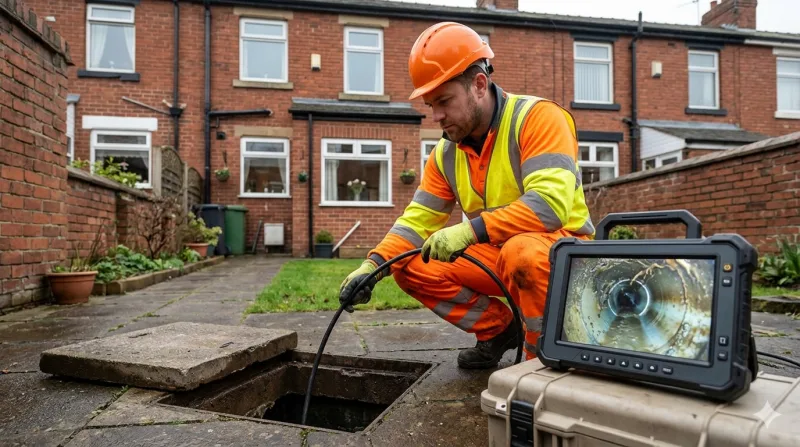
A commercial drain survey is more comprehensive than a residential one:
Extended Coverage
The survey typically covers not just the main drain from the building to the public sewer, but also:
- All internal soil stacks and waste runs.
- Grease traps and other treatment systems.
- Gully drains and surface water systems.
- The connection to the public sewer and, if possible, any shared drains serving other properties.
Additional Testing
Beyond visual inspection, commercial surveys often include:
- Water testing to confirm infiltration or exfiltration (water leaking in or out).
- Pressure testing of the system to confirm it is water-tight.
- Flow rate measurement to confirm the system can handle expected discharge volumes.
Detailed Reporting
Commercial reports typically include:
- A drainage plan showing all runs and connection points.
- Condition grading of each section using WRc standards.
- FOG management assessment if a grease trap is present.
- Compliance recommendations relating to environmental permits or trade effluent agreements.
- Prioritised repair recommendations with cost estimates.
Certification
Many commercial surveys produce a report that can be used for insurance purposes, compliance documentation, or to support applications for trade effluent agreements with United Utilities.
Cost of Commercial Drain Surveys
Commercial surveys are typically more expensive than residential ones due to the extended scope:
- Small commercial property (up to 500m²): £400–£600. Similar to a larger residential property but with more complex systems.
- Medium commercial (500–2000m²): £600–£1,000. Multiple floors, multiple drain runs, grease traps.
- Large commercial or industrial: £1,000–£2,500+. Multi-building sites, treatment systems, extensive networks.
For multi-occupancy buildings, the cost is often shared among tenants via the service charge.
Prevention and Maintenance Strategy
The most cost-effective approach to commercial drainage is prevention:
- Regular surveys — every 2–3 years for most commercial properties, annually for high-waste businesses like restaurants.
- Preventive maintenance — regular grease trap emptying, drain jetting, descaling.
- Staff training — ensure staff know not to pour grease down drains, not to flush inappropriate items, and to report drainage problems quickly.
- Documentation — keep records of all maintenance, surveys, and repairs to demonstrate compliance if questioned by regulators.
An annual survey and preventive maintenance programme costs £500–£1,500 per year depending on the property size. An emergency failure, by contrast, can cost £5,000–£10,000 plus business interruption costs.
Bottom Line for Manchester Businesses
Commercial drainage is not optional for business owners and landlords. Regulatory compliance, health and safety, and protection of your investment all depend on understanding the condition of your drainage system.
A professional CCTV drain survey is the foundation of good drainage management. Combined with a preventive maintenance programme, it keeps your drainage working reliably and ensures you meet regulatory obligations.
If you operate or manage a commercial property in Manchester and need a drain survey, or if you want to establish a preventive maintenance programme, get in touch. We have extensive experience with commercial drainage and can provide detailed reports meeting compliance and insurance requirements.
Need professional advice?
Our Manchester drainage engineers are happy to discuss your situation. Call us for a free, no-obligation chat.